Circularity: Finding Value in What Already Exists

Circularity in Food and Beverage: Finding Value in What Already Exists
Circularity is often treated as a sustainability concept. In food and beverage, it should be treated as an operating discipline. At its simplest, circularity means looking at what already leaves a process and asking whether it still has value.
That includes raw material losses, rejected product, heat, water, packaging, by-products, downtime, rework, cleaning losses, and underused equipment capacity. These are not just environmental issues. They are cost, productivity, quality, and capital planning issues.
The Opportunity Is Already Inside the Facility
Food and beverage operations are full of recurring flows. Raw materials enter, finished products leave, and every step in between consumes energy, water, labour, packaging, chemicals, refrigeration, compressed air, steam, and time.
When product is lost, the cost is rarely just the ingredient. It can also include packaging, labour, cleaning, wastewater, energy, rework, lost line time, and reduced throughput. A plant may be paying for the same loss several times without seeing the full picture.
This is why circularity belongs in operational review, energy management, automation planning, and capital decision-making. It connects losses that are often managed separately.
Better Questions Create Better Opportunities
The shift is simple: stop asking only how to dispose of something. Start asking why it exists, what it costs, and whether it can still do useful work.
Better questions include:
- What leaves the process every day?
- Which losses have become “normal”?
- What is the true cost of this loss?
- Can it be reduced before it is created?
- Can it replace something we buy or consume?
- Could another process, site, supplier, customer, or partner use it?
- Is this a waste issue, or a yield, quality, automation, maintenance, or controls issue?
- Would better metering, sensing, or line data change the decision?
- Are we adding capacity because of growth, or because losses are unmanaged?
- How will we prove the improvement worked?
These questions move circularity from a slogan to a practical method for finding stranded value inside daily operations.
Automation Belongs in the Circularity Conversation
Automation is often justified by labour savings, but in food and beverage the larger value may come from yield, consistency, reduced waste, and uptime.
Next-generation automation, sensors, machine vision, robotics, advanced controls, and AI-supported monitoring can reduce losses before they become waste streams. That can improve fill accuracy, portion control, cutting yield, product handling, packaging alignment, changeover speed, cleaning sequence control, quality detection, and maintenance planning.
Waste reduction and productivity improvement are often the same opportunity viewed from different angles.
Build Circularity Into Capital Planning
The best time to capture circularity value is before the next project is built.
A new line, boiler, compressor, wastewater system, packaging format, or building expansion should not be assessed only on first cost and immediate capacity. It should also be tested for flexibility, recoverable value, future utility impact, cleaning burden, maintenance access, and avoidable waste.
Before approving capital, ask whether the project reduces waste or creates more of it, whether recoverable heat or water will be ignored, whether metering and controls should be added now, and whether the decision improves resilience or locks in higher operating cost.
Closing Thought
Circularity in food and beverage does not need to be abstract. It is a disciplined way to reduce waste, improve productivity, manage utilities, plan capital, and make better use of the resources already moving through the operation.
Every recurring output should be tested against three practical questions:
- Can it be reused internally?
- Can it offset a purchased input nearby?
- Can it become a revenue stream or avoided-cost stream?
That is where circularity becomes commercially useful for food and beverage.
At Joly Solutions, we help organizations look across energy, infrastructure, production, utilities, and operational risk to identify practical opportunities that improve performance, reduce waste, and support more resilient investment decisions.

Electrification Challenges + Opportunities
Electrification Is Becoming an Infrastructure Coordination Challenge
Most people will see a small residential electrical upgrade.
I see a warning sign for the scale of infrastructure transformation still ahead of us.
Recently, trenching work began in my neighbourhood to support a residential electrical service upgrade. At first glance, it appears routine. In reality, it highlights a much larger issue emerging across Ontario and much of Canada: local electrical infrastructure is increasingly reaching practical capacity limits.
In this case, the existing neighbourhood distribution transformers were already effectively tapped out, requiring a significant new feed extension down the street to accommodate additional electrical demand.
Now scale that nationally.
Much of the public discussion surrounding electrification continues to focus on generation capacity. While generation is important, many of the more immediate constraints are increasingly appearing deeper within the system itself:
- local distribution infrastructure,
- corridor capacity,
- municipal coordination,
- utility sequencing,
- civil construction impacts,
- and long-term recoverability under growing dependence on electricity.
If a single residential upgrade already requires this level of civil disruption, what happens when we simultaneously layer:
- EV adoption,
- heat pumps,
- industrial electrification,
- distributed energy resources (DERs),
- battery storage,
- greenhouse expansion,
- AI and data infrastructure growth,
- and broader building electrification across entire communities?
The challenge is no longer simply “adding load.”
The challenge is coordinating infrastructure renewal at a scale and pace the country has not previously experienced.
If upgrades continue to occur reactively — property-by-property, feeder-by-feeder, and application-by-application — the long-term cost, disruption, and coordination burden become extremely difficult to manage.
There may be a much larger opportunity emerging here.
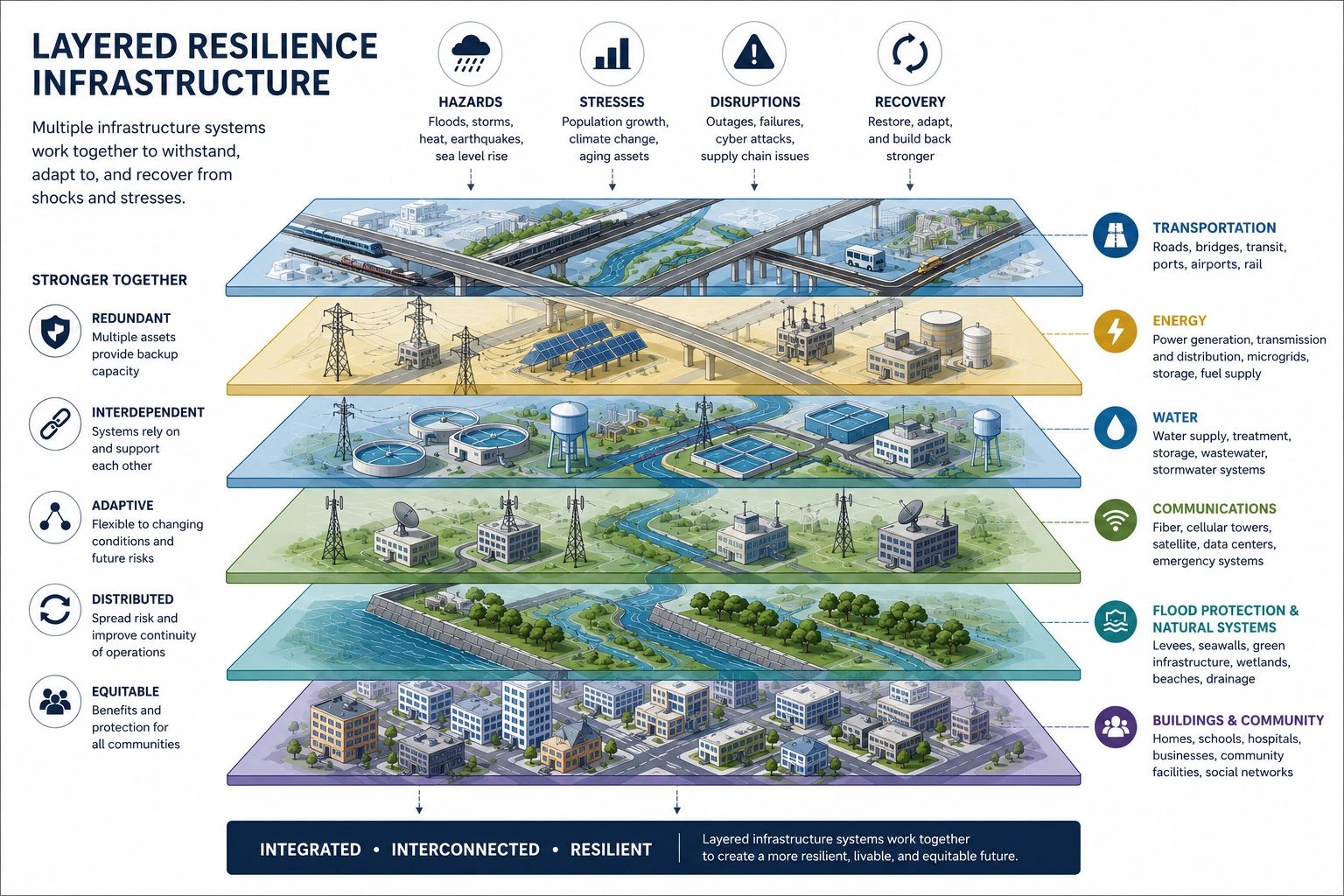
Rather than fragmented upgrades, Ontario and other jurisdictions could increasingly move toward bundled, corridor-based modernization strategies that integrate:
- local distribution upgrades,
- DER readiness,
- resilience planning,
- thermal integration,
- municipal reconstruction,
- communications infrastructure,
- and long-term capacity planning simultaneously.
The trench opened today for one customer could potentially support twenty years of future infrastructure requirements if approached systematically.
This is where many of the broader discussions currently underway across the energy and infrastructure sector become increasingly important. Organizations and initiatives such as the OEB, IESO, OECA, EDA, PULSE, PowerShare, local distribution companies (LDCs), municipalities, and infrastructure operators are all beginning to confront aspects of this challenge from different perspectives.
The engineering itself is difficult.
But the larger challenge may ultimately be coordination:
between utilities, municipalities, regulators, operators, infrastructure owners, planners, and funding structures.
Canada is not simply entering an energy transition.
We are entering an infrastructure coordination challenge of extraordinary scale.
Grid Collaboration - Sharing Information with Stakeholders

Electrification Is Here. It’s Time to Move from Prediction to Integration
Three structural forces are converging:
1. Transportation electrification, including private EVs, municipal fleets, transit systems, and freight vehicles.
2. Thermal electrification through residential and commercial heat pumps, hybrid heating systems, and district energy integration.
3. Industrial re-electrification driven by EV manufacturing, critical minerals mining, hydrogen production, and data centres.

The Growing Gap
Provincial electrification strategies in Canada are diverging in their implied system scale, capital intensity, and institutional burden. Comparative analysis indicates that long-term outcomes are shaped not only by resource endowments, but by how demand, land use, and industrial development are integrated into infrastructure planning.
Recent modelling by Québec and emerging experience in British Columbia illustrate that high-electrification outcomes are not singular in design. System size, peak exposure, and financing burden are strongly influenced by institutional choices made early in the transition. Ontario’s modelled pathways sit between these approaches, reflecting both structural constraints and policy choices.
Understanding Layered Infrastructure